My first real encounter with Buddhist wisdom came through a book.
I picked up Reflections on a Mountain Lake by Tenzin Palmo and what struck me most wasn't the fact that she had spent 12 years meditating in a Himalayan cave — remarkable as that was — but what she said about it. When asked about her time in retreat, her response was simple: "That was the past. I don't dwell on it."
People saw her experience as extraordinary, but to her, it was just practice. "Those years are gone."
That hit me hard. I had expected a gripping story about isolation and breakthroughs, but what I found was something more subtle — and more profound. What's the point of romanticising the past or clinging to stories that are already gone? What truly matters is the here and now.
That moment shifted something in me. Meditation stopped being a curiosity and became a way of life. And exploring Buddhism became something I couldn't put down.
Fast forward to 2025, I signed up for a three-day silent retreat at a Buddhist monastery in Wollongong, near Sydney. It was a beautiful, quiet container focused on mindfulness, simplicity, self-reflection and powerful teaching.
What I want to share with you here are not formal teachings, but reflections. These are the insights that stayed with me after the retreat, and which I've kept returning to long after it ended. I've gathered them into six themes — not as a complete list, but as the realisations that touched me most.
1. Surrender and Trust
During the retreat, I was reminded of an old story about a Chinese farmer that beautifully illustrates the idea of surrender and trust.
One day, a farmer's horse ran away. The neighbours rushed over and said, "That's terrible!" The farmer simply replied, "Maybe."
The next day, the horse returned, bringing seven wild horses with it. The neighbours exclaimed, "How wonderful — now you have eight horses!" The farmer answered, "Maybe."
Later, the farmer's son tried to ride one of the new horses, fell, and broke his leg. The neighbours cried, "What bad luck!" The farmer responded, "Maybe."
Not long after, the army came to the village to recruit young men. They saw the son's broken leg and left him. The neighbours cheered, "How fortunate!" Once again, the farmer said, "Maybe."
What looks like "good" or "bad" in the moment may not be so clear in the bigger picture. Life unfolds in ways we can't predict. The farmer's wisdom was in not clinging to labels, but meeting each event with openness.
2. Impermanence
One of the core teachings in Buddhism is impermanence, or anicca. Nothing stays the same. Joy, sadness, clarity, confusion — everything flows.
If you're going through a hard time, know that this phase will eventually shift. And if you're in a good place, savour it — but don't fear its end.
Our suffering often comes not from the change itself, but from resisting it. We cling to pleasure because we want it to last forever, and we push away pain because we fear it will never end. Yet both are temporary by nature.
Understanding impermanence brings freedom. When we see that nothing is fixed, we can stop clinging to the highs or rushing through the lows. Instead, we can meet each experience with a more balanced presence, knowing that it too will pass.
3. The Middle Path
One of the central teachings of Buddhism is the Middle Path — the way of balance. It is about avoiding extremes, whether that's chasing constant pleasure or falling into harsh self-denial.
In daily life, it's easy to get pulled to one side or the other. We label experiences as either good or bad and swing between clinging and resisting. But the Middle Path invites us to pause and look at both sides: every joy comes with its challenges, and every difficulty holds hidden lessons.
There's a story that illustrates this beautifully — the tale of the cracked pot.
A water bearer carried two pots: one perfect, the other with a crack. Each day the cracked pot leaked water and felt ashamed of being flawed. Until one day the water bearer pointed out the flowers blooming along its side of the path — flowers nourished by the water that had dripped out. What the pot saw as weakness had quietly created beauty all along.
The Middle Path reminds us that life is never one-sided. What we call flaws or failures may be part of a greater balance, often serving us, and others, in ways we don't immediately see. Balance isn't about perfection. It's about recognising both sides and finding steadiness in the whole.
4. Light and Darkness
On retreat, I noticed how often my mind swung between fear and kindness, doubt and clarity. It reminded me of an old story — the tale of the two wolves.
An elder tells his grandson: "Inside each of us are two wolves. One is anger, envy, fear, shame. The other is love, compassion, kindness, truth." The boy asks, "Which wolf wins?" The elder replies, "The one you feed."
Both wolves are always there. The practice is not to deny the darker one, but to recognise it without letting it lead. Every thought, word, and action feeds one of the wolves, and each day, we get to decide which one grows stronger.
In Buddhism, this mirrors the teaching that life is never one-sided. Every situation carries both support and challenge. Trying to live with "only positive, no negative" is unrealistic, and it only increases suffering. True freedom lies in seeing both, accepting both, and consciously choosing what we will nourish.
5. Happiness and Satisfaction
Any happiness that depends on the external world will never fully satisfy. True happiness comes from within. It might sound cliché, but when life strips things away and tests us, inner strength shows its true value. We are the heroes of our own lives — nothing outside of us can replace that.
Buddhism calls this dukkha, often translated as "suffering," but a better word is "unsatisfactoriness." It's that restless sense of something is missing. We feel it when we chase after what we don't have — the perfect partner, more money, a different lifestyle. And we feel it when we resist what life brings — aging, change, uncertainty, or loss.
The problem isn't life itself, but the way we hold it. We want the good times to stay forever, and we want to skip over the hard parts. But life will always include both.
The shift begins when we stop fighting this truth. When we appreciate what's here instead of grasping for what isn't. When we accept what must change instead of exhausting ourselves resisting it.
Happiness, then, isn't about getting rid of challenges. It's about learning to live with both sides of life — joy and pain, gain and loss — without losing our balance. And compassion is what helps us do that: meeting ourselves and others with gentleness, even in the middle of difficulty, transforms struggle into growth.
6. Interconnectedness
One of the most powerful insights from Buddhism is that nothing, and no one, exists on its own. Everything is connected.
Thích Nhất Hạnh called this interbeing: when you look deeply into a flower, you also see the sunshine, the rain, the soil, and the gardener. The flower can only exist because of everything else around it. In the same way, our lives are woven together with countless people and conditions.
The boundary between "me" and "you" is far more fluid than we often think. When we hurt someone else, that harm doesn't stop with them — it circles back to us, whether through guilt, karmic patterns, or habits that close our own hearts. And when we care for others, we strengthen compassion and peace within ourselves.
Understanding this interconnectedness changes the way we move through the world: every act of harm ripples outward and back, and every act of kindness expands far beyond what we can see.
Closing Reflections
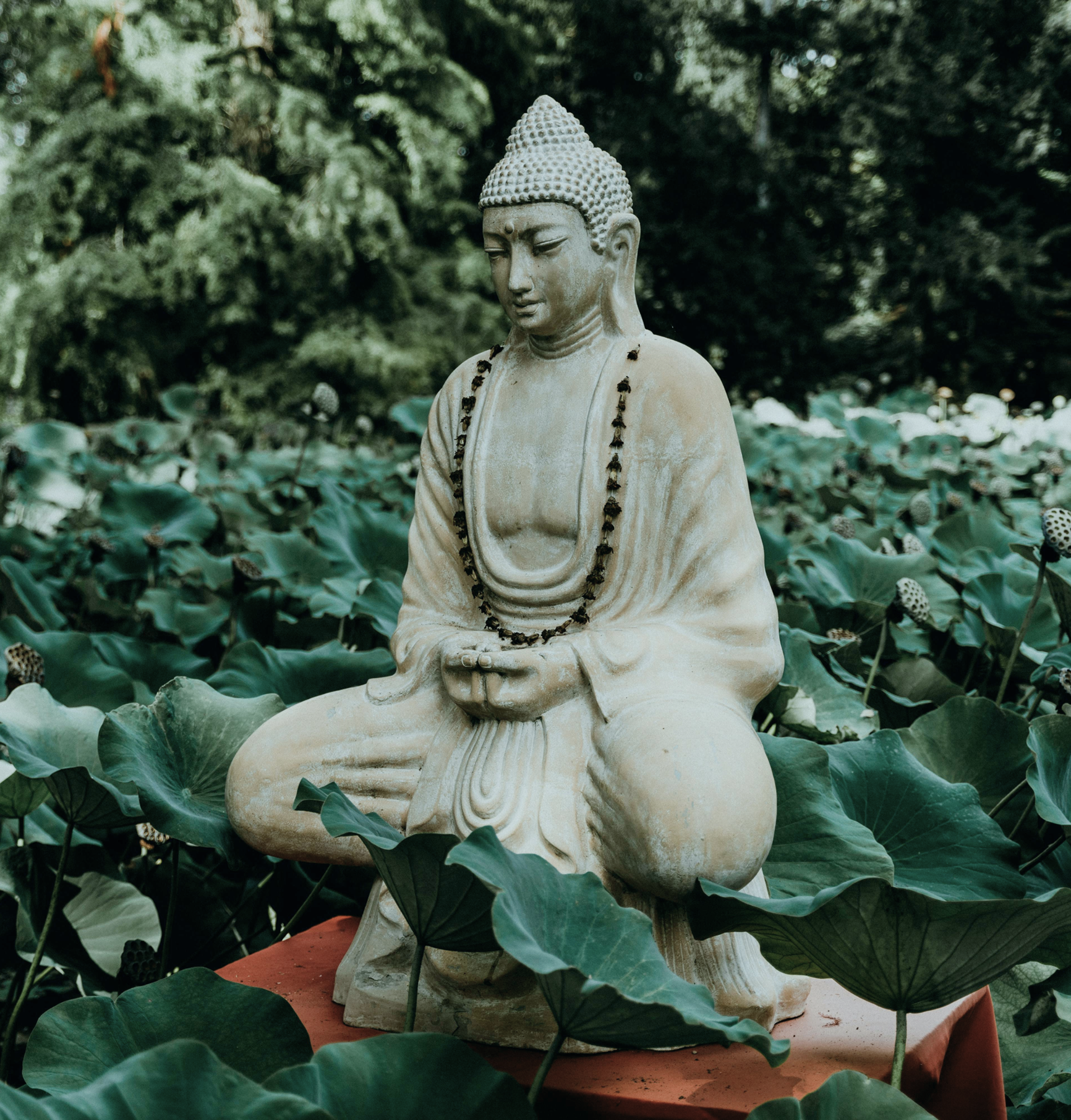
One image that stayed with me after the retreat is the lotus. In Buddhism, the lotus symbolises how something beautiful can grow even from muddy water. The mud isn't separate from the flower — it's what makes the flower possible.
Life is like that. The struggles and challenges we go through aren't just obstacles — they're part of what shapes us. Just as water beads roll off lotus petals without clinging, the practice is to move through life's experiences without getting stuck in craving or aversion — present, open, and free.
Remembering this helps me meet difficulties with more patience and trust — knowing that even in hard times, something meaningful can grow.
If these reflections resonate, I invite you to explore meditation or even a retreat of your own — small steps that can open big shifts.
If you'd like to explore Buddhist wisdom more deeply, these books have been especially valuable to me:
Lama Surya Das
Reflections on a Mountain Lake
Tenzin Palmo
The Tibetan Book of Living and Dying
Sogyal Rinpoche
Eckhart Tolle — not a Buddhist text, but many of its principles echo Buddhist wisdom, shared in simple, modern language